Acquisition · Renovation budget
How to estimate a renovation budget before you buy a property
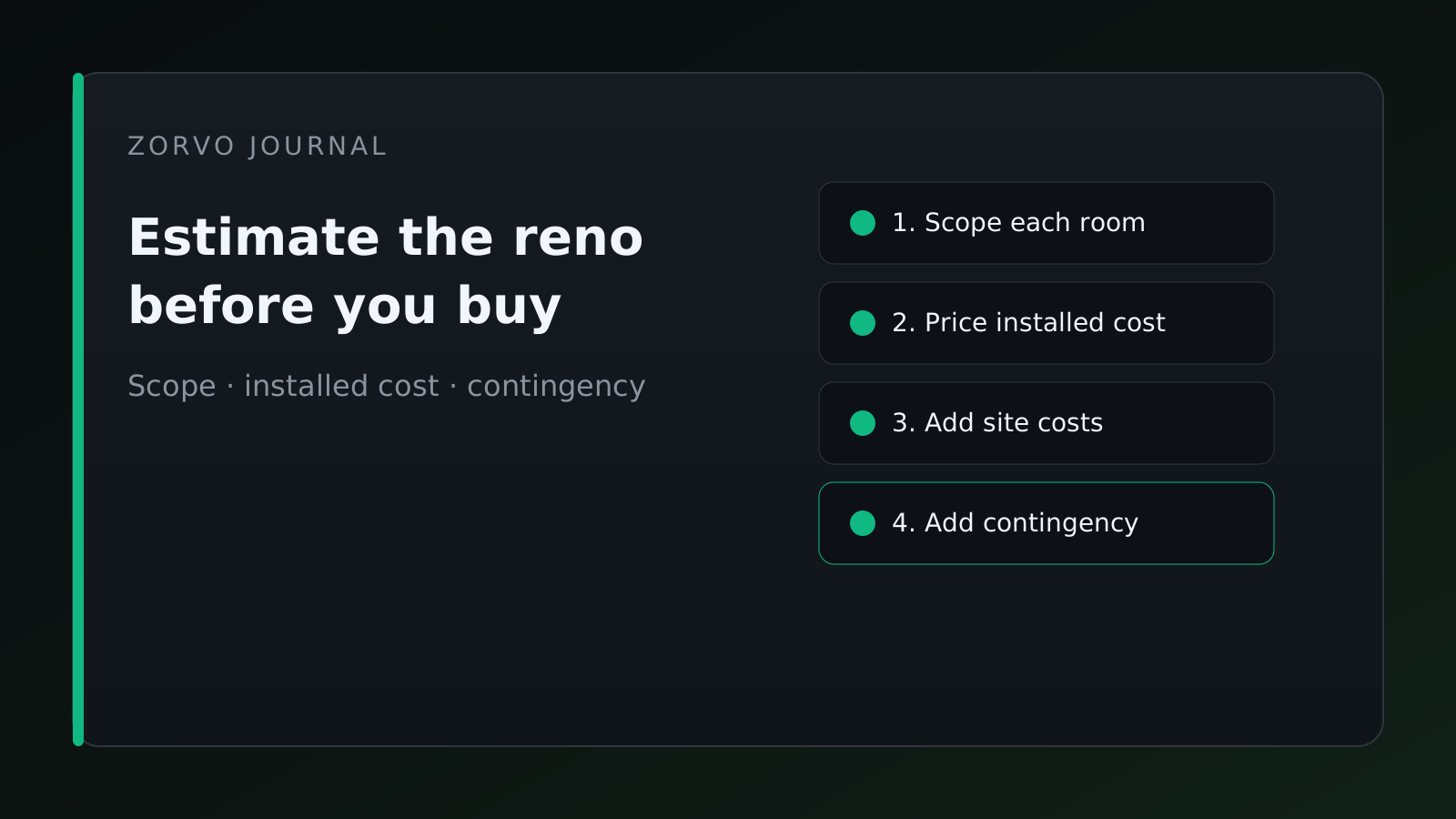
To estimate a renovation budget before you buy, write down the scope you'd actually do in each room, work out the installed cost (materials plus labour) of that scope, then add the costs that sit outside the rooms, such as permits, rubbish removal and site protection, plus a contingency for what you can't see. The estimate is only as good as the scope behind it, so build it room by room rather than from a whole-house rule of thumb. Do it before you make an offer, while walking away is still easy.
Key takeaways
- Start with scope, not a number: decide what you'd do in each room, and what you'd leave alone.
- Price each room's scope as installed cost, then add non-room costs like permits, levies, rubbish and protection.
- Add a contingency for unknowns. Older homes, wet areas and anything behind walls deserve more caution.
- The items most often forgotten are the in-between ones: waterproofing, electrical upgrades, making good, disposal and final cleaning.
- A pre-purchase estimate is a filter, not a quote. Inspections and trade quotes come next.
How do you estimate renovation costs before buying a house?
Walk the property room by room, list the work you'd do, and price that work as installed cost. Then add site and compliance costs and a contingency. That gives you a budget range you can test against the price you're willing to pay.
A practical order:
- Set your exit first. If you're renovating to sell, work out what renovated comparable properties on or near the street sell for. Our guide to renovations that close the gap explains why the scope should answer to that ceiling.
- Walk and scope each room. Note what stays, what's refreshed and what's replaced (see how to write a renovation scope of works, room by room).
- Price the scope as installed cost. Materials plus labour for each line, not product prices alone (more on that in what "installed cost" means).
- Add the non-room costs from the checklist below.
- Add a contingency for what you can't see.
- Sense-check it against the purchase price and your exit, and decide whether the deal still works with a buffer.
Why don't per-square-metre estimates work for a renovator?
Because two houses of the same size can need completely different work. A per-square-metre figure averages away the things that actually drive renovation cost: which rooms you touch, how far you strip them back and whether services move.
A house that needs paint and floors and a house that needs a new kitchen, two bathrooms and rewiring might share a floor area and almost nothing else. Pricing room by room, with only the work you'd actually do, keeps the estimate tied to the property in front of you.
What costs do people forget in a renovation budget?
The costs people forget are rarely the big visible items. They're the preparation, compliance and finishing work around them, plus anything that isn't inside a room at all.
Renovation budget checklist: commonly missed items
| Category | Items to include or rule out |
|---|---|
| Demolition and disposal | Strip-out labour, skip bins or rubbish removal, tip fees, asbestos testing and licensed removal if present |
| Wet areas | Waterproofing, drainage changes, floor regrading, exhaust fans |
| Services | Switchboard upgrade, rewiring, extra power points, smoke alarms, hot water, gas work, plumbing moves |
| Structure and fabric | Rot, termite damage, subfloor and stumps, cracking, roof and gutter repairs |
| Making good | Patching walls and ceilings after demolition, matching floors, trims, skirting and architraves |
| Compliance | Building permit and surveyor fees, council fees, government levies where they apply |
| Site | Floor and neighbour protection, access, temporary toilet or power if needed |
| Fit-off and finish | Appliances, tapware, door hardware, lighting fixtures, window furnishings, final clean |
| Outside | Facade repairs, paint, fencing, paths, garden and street appeal |
In Victoria, Consumer Affairs Victoria lists several of these compliance costs, including building fees, council fees and government levies, as things to check are included in a contract price (CAV: managing project costs). If you're flipping, keep holding, buying and selling costs in your feasibility too; they just sit outside the renovation budget.
How much contingency should you allow in a renovation budget?
Enough to absorb what you can't see before work starts, and more for older or more complex jobs. In Victoria, Consumer Affairs Victoria's guidance is to do your own detailed estimate, including your fixture and fitting selections, and add 15 per cent for unplanned costs (CAV: managing project costs).
Treat that as a starting point rather than a rule. Raise your allowance when:
- the house is older, or has had unknown DIY work
- the scope opens up wet areas, floors or walls
- services are being moved or upgraded
- selections aren't final yet
Keep the contingency as a separate line. If it's mixed into room budgets it tends to get spent on upgrades rather than surprises.
What can't you see when inspecting a renovator?
Most of what blows a renovation budget is behind linings, under floors or in the roof: water damage, old wiring, failed waterproofing, rot, termite damage and asbestos. A walkthrough can flag the warning signs, but it can't confirm what's there.
Asbestos is a good example. In Victoria, the state government's asbestos site notes that asbestos-containing materials were commonly used in buildings before the 1990s, and advises being aware of where asbestos may be present before repairs, renovation or demolition in a house built before 1990 (Asbestos Victoria: finding and identifying). If the property's age puts it in that range, allow for testing and possible licensed removal.
Before committing, it's worth getting a pre-purchase building and pest inspection, and asking a licensed electrician or plumber to look at anything that worries you. Each finding either confirms your estimate or tells you to adjust your offer.
Can an app help you estimate a renovation budget before you buy?
Yes, if it prices the scope you'd actually do rather than the floor area. Zorvo Flip lets you walk a property on your phone, room by room, and turns your scope into an installed-cost budget (materials plus labour, without a builder's margin added). It only prices what you enter: a room left empty or marked "Not in scope" is priced at zero and left out of the total, so the figure reflects your plan rather than a whole-house guess. Add your non-room costs and contingency on top. Try Flip on a real project for 3 months, then A$19/month.
If you're still deciding which properties are worth walking, Zorvo Find analyses suburbs, properties and renovation signals to rank homes with renovation potential worth investigating. And if the lead is off-market, the same scope-first approach applies; see off-market property deals in Australia.
Frequently asked questions
How do I estimate renovation costs before buying a house?
List the work you would do in each room, price that scope as installed cost (materials plus labour), then add permits, rubbish removal, site protection and a contingency. Build it room by room rather than from a whole-house rule of thumb.
How much contingency should I add to a renovation budget?
In Victoria, Consumer Affairs Victoria suggests doing your own detailed estimate and adding 15 per cent for unplanned costs. Allow more for older homes, wet areas, moved services and anything you can't inspect.
What are the most common hidden costs in a renovation?
Waterproofing, electrical upgrades, plumbing moves, making good after demolition, rubbish removal, asbestos testing or removal, permits and levies, and final cleaning. Problems behind walls and under floors are the biggest unknowns.
Why not use a cost per square metre for a renovation?
A per-square-metre figure ignores which rooms you are renovating and how much work each needs. Two houses of the same size can need very different renovations, so price the actual scope room by room.
Should I get trade quotes before making an offer?
If time allows, yes, at least for the biggest or riskiest items. Otherwise use a room-by-room estimate to decide whether the property is worth pursuing, then get inspections and quotes before you commit.
Is a pre-purchase renovation estimate the same as a quote?
No. A pre-purchase estimate is a planning figure to help you decide whether a property is worth buying. A quote is a trade's or builder's price to do a defined scope, and it can change once the property is inspected properly.
Sources and further reading
- Consumer Affairs Victoria: managing project costs: detailed estimates, contingency, fees and levies
- Asbestos Victoria: finding and identifying asbestos: where asbestos may be present in older homes
This article is general information only, not financial or building advice. A renovation estimate is not a guarantee of cost or return. Get independent inspections and professional advice before you buy.